Hip Hip Hooray, the temperature got to 62 degrees today!!! We began our travels west on the Trans-Canada highway. Our destination was Gros Morne National Park on the west coast of Newfoundland, a 275 mile drive. Gros Morne is a bit like Rocky Mountain National Park, but on the ocean, actually the Gulf of St. Lawrence. When we arrived the sun was out, so we took a short hike to the water to see the sea and embrace the sun.
We are staying in a small village called Rocky Harbor. As we have traveled across Newfoundland, we have learned that everyone lives on the water in a village nestled into a cove. The only settlements not on the water are located on the Trans-Canada highway. In the history of Newfoundland, the English arrived first and got the "good spots", the coves. When the Irish came, they got the land that was left above the harbors. It was not very good land for farming, as much of Newfoundland is either rocks or bogs. Maybe that is why some many Irishmen left.
However, half of the island has some Irish heritage and you can hear it in their speech. They have a lilt that I am sure is traced to their Irish roots. Newfoundland is the only province that has its own dictionary, and many of the coves have different dialects. The people speak very quickly and you have to pay attention so that you can understand. Yesterday there were two tourists from Italy on our boat and although they could speak some English, I am not sure how they managed to understand the boat guide as I had a hard time doing so myself.
Our hotel has a hot tub, so after dinner we sat outside in it and enjoyed that fact that it wasn't raining! There was the opportunity to hear more local music tonight, but we felt we had heard the Ode to Newfoundland enough and decided to call it a night.
Diane
Wednesday, August 10, 2011
Tuesday, August 9, 2011
Twillingate day 2
We booked a whale watching boat tour in hopes of seeing whales and ice bergs. Unfortunately, we didn't see either, but we saw 2 hours of Newfoundland shoreline, some of which you can see below.
We did learn a lot about fishing, however. Who knew that the tongue and cheeks of cod were the best parts!!! In the past, young boys would spend their time cutting the tongues out of cod and then sell them in the villages door to door. The restaurant we ate in last night did have cod tongue as a menu choice, so I guess it must be true.
After a lunch of seafood chowder and carrot muffins, we took a hike to the highest spot in the area--328 feet (remember we started at sea level.) We had a 360 degree panoramic view. The rain held off and hiking in 54 degree weather has its advantages--very few mosquitoes and black flies.
Diane
The lady who was our tour guide was the brother of the boat skipper, and they had both been fishermen. So she knew a lot about life and the challenges faced by fishermen in these little remote coastal villages all along the Newfoundland coast. It is a hard life, and many are leaving for higher paying and more secure jobs. Many are going to work with the off-shore oil drilling operations. It was interesting to hear her perspective of the whole issue.
Our afternoon hike was a good one, and one we were waiting to do. Too much sitting time in the car lately. It was fun and enjoyable and good exercise. Temperatures again today were in the low 50s, with rain sprinkling on and off all day long.
I bought a bottle of the local alcohol. They call it Screech, and talk about it all the time. So-I went into the local store and asked for a bottle. It's Jamaican rum. We'll see how it goes down.
Tonight we went to hear the Split Peas, a local group of women who sing folk songs. While I was buying the tickets, I met two of them. One of the songs they sang explained why Newfoundland has a time zone of 30 minutes ahead of Atlantic time. According to the song, when God made the world, he spent an extra 30 minutes on Newfoundland!
Joe
We did learn a lot about fishing, however. Who knew that the tongue and cheeks of cod were the best parts!!! In the past, young boys would spend their time cutting the tongues out of cod and then sell them in the villages door to door. The restaurant we ate in last night did have cod tongue as a menu choice, so I guess it must be true.
After a lunch of seafood chowder and carrot muffins, we took a hike to the highest spot in the area--328 feet (remember we started at sea level.) We had a 360 degree panoramic view. The rain held off and hiking in 54 degree weather has its advantages--very few mosquitoes and black flies.
Diane
The lady who was our tour guide was the brother of the boat skipper, and they had both been fishermen. So she knew a lot about life and the challenges faced by fishermen in these little remote coastal villages all along the Newfoundland coast. It is a hard life, and many are leaving for higher paying and more secure jobs. Many are going to work with the off-shore oil drilling operations. It was interesting to hear her perspective of the whole issue.
Our afternoon hike was a good one, and one we were waiting to do. Too much sitting time in the car lately. It was fun and enjoyable and good exercise. Temperatures again today were in the low 50s, with rain sprinkling on and off all day long.
I bought a bottle of the local alcohol. They call it Screech, and talk about it all the time. So-I went into the local store and asked for a bottle. It's Jamaican rum. We'll see how it goes down.
Tonight we went to hear the Split Peas, a local group of women who sing folk songs. While I was buying the tickets, I met two of them. One of the songs they sang explained why Newfoundland has a time zone of 30 minutes ahead of Atlantic time. According to the song, when God made the world, he spent an extra 30 minutes on Newfoundland!
Joe
Monday, August 8, 2011
Twillingate
We left St. John's in grey skies and cold, but no rain. Our goal was Twillingate--the Iceberg Capital of the world. The drive was about 275 miles and it took us about 6 hours to get here. Our drive followed closely the coastline allowing us to see how the water influences life here. We stopped at a the information center for the Terra Nova National Park. While we were there a group of young German students came into the center. They were from Munich on a choir tour. In the center they did an impromtu concert, singing a German folk song and a Newfoundland song. We didn't know the German song, but had heard the Newfoundland song and clapped along with all of the people in the crowd, just like we were real "newfies."
There are no colleges in this part of Newfoundland so we had to find "real" accommodations.
This town is only 2500 people, The geography of northern Newfoundland reminds me of the high alpine region of Colorado, but with more lakes and ocean bays protruding in a several points along the way. It's also more green. The temperature today went from a low of 49 degrees (F) to a high of 59 degrees (F). The roads again were lightly traveled in most areas.so the options were not many and we had to make a few phone calls to find a place. The Kelsie Inn had room for us for two nights and so that is our home for now.
Once we settled into the room we took a drive to check out the town. We headed to the lighthouse. Every town in Newfoundland seems to have a lighthouse and we were rewarded by sighting an iceberg!!! It was out in the distance but definitely there. We are going to take a boat ride tomorrow looking for icebergs and whales. Hopefully we can get up closer then.
Diane
The geography of northern Newfoundland reminds me of the high alpine region of Colorado, but with more lakes and ocean bays protruding in a several points along the way. It's also more green. The temperature today went from a low of 49 degrees (F) to a high of 59 degrees (F). The roads again were lightly traveled in most areas.
Diane and I are a good team. I do most of the driving and she works the phone to while we drive to arrange lodging at our next few stops. We work well together.
This will probably be the farthest north in Newfoundland we will get on this trip. There is another pennisula that goes farther north for a few hundred miles each way, but we don't have time on this trip. Maybe some time in the future,
Tomorrow we will stay right here in this little fishing village and go whale/iceberg hunting. There are several hundred whales here off the coast, and late this afternoon, we drove to a high viewing point, and saw our first iceberg flowing through the channel.Hopefully we'll see more of both tomorrow, and then do some hiking in the afternoon, and listen to some local music tomorrow night.
Joe
There are no colleges in this part of Newfoundland so we had to find "real" accommodations.
This town is only 2500 people, The geography of northern Newfoundland reminds me of the high alpine region of Colorado, but with more lakes and ocean bays protruding in a several points along the way. It's also more green. The temperature today went from a low of 49 degrees (F) to a high of 59 degrees (F). The roads again were lightly traveled in most areas.so the options were not many and we had to make a few phone calls to find a place. The Kelsie Inn had room for us for two nights and so that is our home for now.
Once we settled into the room we took a drive to check out the town. We headed to the lighthouse. Every town in Newfoundland seems to have a lighthouse and we were rewarded by sighting an iceberg!!! It was out in the distance but definitely there. We are going to take a boat ride tomorrow looking for icebergs and whales. Hopefully we can get up closer then.
Diane
The geography of northern Newfoundland reminds me of the high alpine region of Colorado, but with more lakes and ocean bays protruding in a several points along the way. It's also more green. The temperature today went from a low of 49 degrees (F) to a high of 59 degrees (F). The roads again were lightly traveled in most areas.
Diane and I are a good team. I do most of the driving and she works the phone to while we drive to arrange lodging at our next few stops. We work well together.
This will probably be the farthest north in Newfoundland we will get on this trip. There is another pennisula that goes farther north for a few hundred miles each way, but we don't have time on this trip. Maybe some time in the future,
Tomorrow we will stay right here in this little fishing village and go whale/iceberg hunting. There are several hundred whales here off the coast, and late this afternoon, we drove to a high viewing point, and saw our first iceberg flowing through the channel.Hopefully we'll see more of both tomorrow, and then do some hiking in the afternoon, and listen to some local music tomorrow night.
Joe
Sunday, August 7, 2011
Newfoundland
For those of you who get up every morning and check our blob first thing, I am sorry that we disappointed you by not writing last night. We were out after midnight last night having a good time and were too tired to blog--but more about that later.
We arrived in Argentia, Newfoundland at 8:30 am Newfoundland time. That is 30 minutes later than Atlantic time. I have never been any place where the time zone changes by 30 minutes, but there must be a reason for this, just like China has only one time zone. The weather has not improved and has only gotten worse--50 degrees and horizontal rain. The pictures of our arrival tell the story.
We were off the boat in 30 minutes and on our way to St. Johns, an hour and a half away. We stopped at a small visitors center in Argentia and discovered that Argentia was one of the first places the US sent resources and troops as a result of the Lend Lease Act at the beginning of WWII. Our trip to St. Johns was made in the rain and we didn't see any moose.
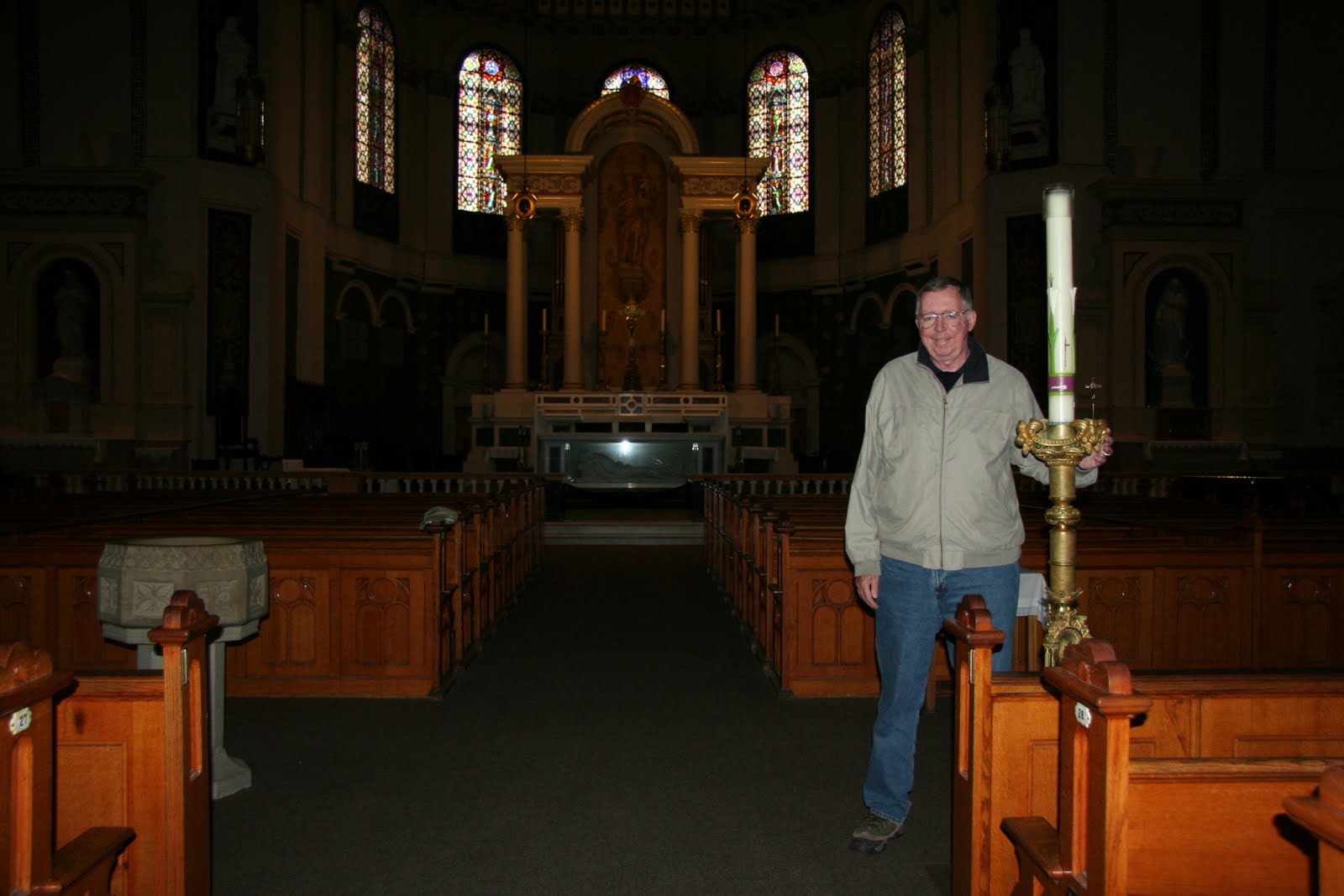
Our first stop in St. Johns was St. John the Baptist Basilica, where we had a baptismal certificate for Elizabeth Furlong from 1849. Coming to the church was one of our motivators for coming to Newfoundland. Elizabeth was Grandpa Burke's maternal grandmother.
Joe was actually able to stand by the baptismal font of his great-grandmother!
St. John's has a modern and very elegant new museum to tell its story to residents and tourists alike. We headed there next to learn about St. Johns, but also to access the archives to see what else we could find about this branch of the family. We had to pay $10 and join the Newfoundland historical society, but we are members for life! This allowed us to discover some new things about the Burkes. Thomas W Kelly (grandpa Burke's maternal grandfather) was also baptized at St. John the Baptist on February 8, 1854. We had this as his birthdate, but it was his baptism date. His parents were Michael Kelly and Mary Murphy. This is information we did not have before. It was exciting to go through the records searching for someone who came before you and then to actually find them! We also found the Elizabeth had a sister named Bridget who was baptized on October 11, 1854. Elizabeth Furlong and Thomas Kelly married, but we could not find a record of their marriage in St.Johns. Perhaps they married in Chicago, that is where their daughter (grandpa Burke's mother) Bridget Catherine Kelly was born.
We checked into our room at Memorial University, a big public university without much charm, but lots of utility and efficiency. Our room is adequate with an interesting layout for bathroom facilities. When I left to take a shower this morning, I told Joe I was going to the south 40 and if I didn't come back after while to come look for me. But we are only paying $55 a night including all the Canadian taxes, which are 15%.
Next, we went to 5 o'clock mass and sat in the pew right behind the baptismal font. I couldn't stop wondering about what the time was like in the mid 1800s when Elizabeth and Thomas were baptized and what hopes and dreams their parents had for these two children. What did they wear? How did they get to the church?
Fortunately for us, this weekend is the 35th Newfoundland and Labrador Folk Festival. This was supposed to have been outside, but the rain, wind and cold forced it inside the city's event center large enough to hold 8000. We came at 6:30 and for the next 5 hours listened to all sorts of folk music--most of it Canadian and much of that "newfie" music, as the locals call it. The people of Newfoundland are very proud of their music heritage, which is a combination of Irish and Scottish. We enjoyed ourselves so much, we are going back tonight for another round!
Today we slept in late--so late we didn't believe Joe's watch when it said 11:30. I told him to check another one, as his is a Chinese knock-off and has been known to not keep accurate time. But the watch works as well in Newfoundland as China and it was correct. After we got ourselves going we had lunch in a restaurant on the harbor and then went to Cape Spear, which is the farthest east you can go on the North American continent. It also has one oldest lighthouses in Canada.
That's all for now! Soon we are off to hear more great music!
Diane
Wow! Looking at the pictures above, you would think that the weather is ruining our vacation. But we are having a ball!
There is something about this part of North America that I love! I told Diane today that I think this is one of my most favorite areas, next to Colorado. Why? I think its because of a couple of factors. One - I like the geographic mixture of oceans, lakes, forests, alpine-like meadows, and rolling hills with well-kept farms that makes you think of Iowa.
But most importantly, I think its the people. Newfoundland is dominated by Irish and Scots. Irish alone are 1/2 of the population. So-over the past few days something has risen up in my DNA or gene pool that has brought out my Irish heritage like never before! I like the people. I like the music, I like the fact that some of Irish ancestors came from here. For some reason, I feel very comfortable here, and would like to learn more about this place.
It's also been an emotional time for me. This trip has really made me think about two things:
1. the sacrifices that our ancestors made in coming to North America, and the fact that we (generations later) have greatly benefited from their heroic deeds; and
2. a whole series of questions relating to immigrants and immigration, including
a. what were these people like;
b. why did they make the decisions that they did, and what were the trials and tribulations that they went through;
c. How did both the Burkes and O'Neills end up in Chicago?
I think I might have come up with a few possible answers here in St. Johns, but it will take too long to explain tonight. More to come.
Joe
Friday, August 5, 2011
Louisburg and the ferry
We awoke to more cool and wet weather, but I think that is the norm here. We headed out to see Fort Louisburg, about thirty minutes from the college. Louisburg is the place in which the English defeated the French in 1758. This defeat led to the English moving on to take Quebec and eliminating France from this part of North America. You may remember all of this from your previous study of the French and Indian war or maybe you don't!
The site is a Canadian national park with about 20 percent of the original buildings reconstructed. Park employees dress in period dress and play the roles of the people living in the buildings. It is sort of a mini Williamsburg. The year represented is 1744, when the French were still in charge. We were greeted at the gate and interrogated to make sure that's we weren't British spies, sort of a 18th century security check. It was only 58 degrees, so I was thankful we didn't have to take our shoes off!
We headed next to board the ferry which had a 5pm departure. The only other time I was on a car ferry was about 35 years ago when we took the ferry from Patras, Greece to Brindisi, Italy. Scott was about 18 months and Peter was 3. I just remember that the cabin was very tiny!
God smiled on us and we got the second to the last cabin on the waiting list. We won't have to spend the night trying to sleep in our chairs. I am writing this from the lounge on the ship. The Atlantic Vision is a Swedish cruise ship that has been converted to carry cars. It is quite nice and still has cruise ship amenities---dining rooms, a gift shop and a game room.
In the lounge 2 old Canadians are singing Canadian country western songs. They just finished singing about a sheep and a moose!
The people on the ship are a mixture of some families with kids who are camping, motorcycle riders and retired people like us. Most are Canadians. Newfoundland is really off the beaten track of most American tourists. I've stopped collecting the names of state license plates and have starting collecting
Canadian province plates instead. I have eight now!
Diane
Thursday, August 4, 2011
Heading East
Today we headed east to Sydney where we will take the ferry tomorrow to Newfoundland. We drove about 4 hours on the Trans Canada Highway and stopped in Braddeck, the town where Alexander Graham Bell had a home. He picked this place because it reminded him of Scotland. We toured the museum which showcased his many ideas and inventions. The picture posted is taken at the lake by the museum. We then headed an hour or so east to Sydney to find out what our new accommodations would be. We are staying at the University of Cape Breton, a small campus that reminds of us of a community college. Our room has two beds and a sink and a bath down the hall. We are getting used to this! The rooms remind us of Space or Saunders Hall at Keuka.
The weather has been quite cool--low 60s and over cast skies. I feel sorry for the Canadians who live here. It is the middle of summer and the weather is more like fall. There is lots of water and I do see an occasional beach, but no one is brave enough to swim!
Diane
We are coming to the end of week one of our four week adventure. We now find ourselves less than 30 kilometers from the farthest eastern point on the North American landmass. To the East is several thousands miles of Atlantic Ocean. Yep, we've come a long way in just seven days!
The geography out here is beautiful, what with the heavily forested rolling hills surrounded by deep water bays, and sprinkled with rivers and lakes. There are also many farmers out here, and in some parts it looks like upstate New York.
A note from yesterday's visit to Pier 21. I was disappointed, in a small way, that the museum only covered the time period of 1908 till 1971, but that is the time that Pier 21 operated. The reason for my disappointment is that it did not pay sufficient attention to all the Irish immigrants that arrived before that time, and that is a great part of our Burke and O'Neill heritage. Our ancestors came through this part of Nova Scotia and Newfoundland in the early to mid-1800s, as our great grandfather Kelly's and grandmother Furlong's parents did, before they were both born in St. John's, Newfoundland around 1850.
Tonight, as we prepare to board the ferry tomorrow for the long 14-hour ride to Newfoundland, I find myself wondering how these people must have felt when they got on the boats in Ireland to take them here to North America. Then, I find myself wondering how and why their children made the decision to keep moving south and west to eventually come to Chicago and the United States. Each of these generations of kin made life and family transforming decisions, which if they had not, would have had tremendous consequences on those generations of us that followed them.
How and why did they make these decisions? How did they feel? How did they deal with the deep stresses of leaving all of their loved ones for a new life far away? Did they have any idea what their decision would mean to those of us generations behind them?
In a way, I feel blessed to be one of the first Chicago Burkes, and maybe O'Neills that have the opportunity to go back to St. Johns, Newfoundland to see where our wandering Irish ancestors lived, prayed, where they were baptized, where they arrived in North America, and where they again left to keep moving on their epic journey west to the US. I say maybe the first Chicago O'Neill because I think that there is a possibility that Uncle Bill O'Neill (my Mom's brother who served as a radio operator on a ship that sailed back and forth across the Atlantic) might have had the opportunity to stop in either Halifax, Nova Scotia or St. John's Newfoundland as his ship waited in one of these ports to become part of one of the many wartime convoys that sailed between North America and Europe.
I think my Dad would be very happy if he knew I was making this trip, as it was his Grandmother and Grandfather who were born and baptized in St. Johns, Newfoundland. I remember when I was growing up, that my Mom and Dad would always engage in discussion of their heritage around St. Patrick's Day. Mom, whose family came right from Ireland to New York would emphasize to us kids that we were full blooded Irish. My Dad, however, who never really disagreed with my mother, would gently tell us we were Americans first, as our grandparents on the Burke side were from Newfoundland. yes, they were from Ireland a long time ago, but they emigrated from Ireland to Newfoundland, and then eventually came from Newfoundland to the United States.
How and when did they leave Newfoundland? Did they go by boat or by train? Did they come through Nova Scotia and New Brunswick and down the East Coast, or come through Quebec. Why did they choose Chicago?
I wish that I knew more about these people!!! It's a shame that we forget our ancestors so fast. Will our great grandchildren know as little about us as we do about these people from Newfoundland? I hope they remember more about us!
Tomorrow is a special day!
Wednesday, August 3, 2011
Halifax Day 2
We woke up to rain but that didn't deter us. We headed to the Canadian Immigration Museum called Pier 21. Pier 21 was the place where immigrants entered Canada from 1928-1971. We took a tour, watched a 3-D movie and spent time enjoying the exhibits. The museum is small, but tells quite well the stories of the people who entered Canada during this time period. One group that affected both Joe and I were the children who were sent from England at the beginning of WWII by their parents so they would be safe. I got a lump in my throat thinking about all of the parents and how their hearts must have been very heavy sending 5 year old's across the ocean to live with people they didn't know. Worse things happened during the war, I know, but this was one event that seemed very touching to me.
One of the exhibits had this statement--Canadians are immigrants with seniority. I thought this worked for Americans too. As we existed the museum, I thought about all of the many relatives who came before us who braved the Atlantic crossing and an unknown world in the US and how grateful we are that they did so.
After the museum we grabbed a quick lunch and took a 2 hour harbor tour of Halifax. Halifax is the second largest harbor in the world after Sydney, Australia. This has allowed Halifax to play a major role since its founding in 1749. The harbor does not freeze so its importance is quite significant.
After our tour, we returned to our room in Alex Hall and relaxed. The picture I downloaded is posted on the inside of the front hall door. Every college has to deal with pigeons. I guess King's College has their own challenge--how to keep them out of the building--at least they don't have bats!
Subscribe to:
Posts (Atom)